Posts

Key Navagraha Information

Image
Click table to enlarge The worship of Bholenath is of course the paramount activity, but dalliance with the Navagraha can be a fun "side quest" within the Sanatan Dharma framework. Yogananda has confirmed in his autobiography that certain astrological gems can bring some relief in various life areas to devotees. I would caution folks, however, that bad karma must be "paid for" in one way or another, so although a gem may delay or temporarily ease some negative aspects of life to smooth things out, in the end you will have to pay the price. If interested, get your Vedic (Jyotish) astrology chart done, and pay attention to which planets are "malefic" or "debilitated" in your chart. If malefic, you can wear the stones of their enemies. If debilitated, you can wear that deity's stone on the appropriate finger, as well as elsewhere on your person. In my case, I purposely wear the stones of my malefic planets so that I can burn through my bad karma...

The Goddess Parvati Temple

Image
While the other Goddesses in the "Big Six"*** receive regular individual worship, we often only see Parvatiji** as an accompaniment to Bholenath, if She is even depicted. That is going to change now, in a big way. When we talk about power, do you know whom in the Big Six has the most power? Parvatiji's Sanskrit name is "Shakti", quite literally 'Power', and She is glorified as the energy and engine behind everything that exists and is in motion. You do the math... Below are some protocols for what we will see in our beloved Devi's temple. Initially I had wanted to do a full-service temple, but I now realize that the language and pronunciation barriers will be impracticable to surmount for busy American professionals and students, the target demographic, and so we will switch gears to double down on our core competencies and what we can offer devotees with authority. Services will be either simple one-to-few-word beej mantras and otherwise entirely in...

The Upanishads

Image
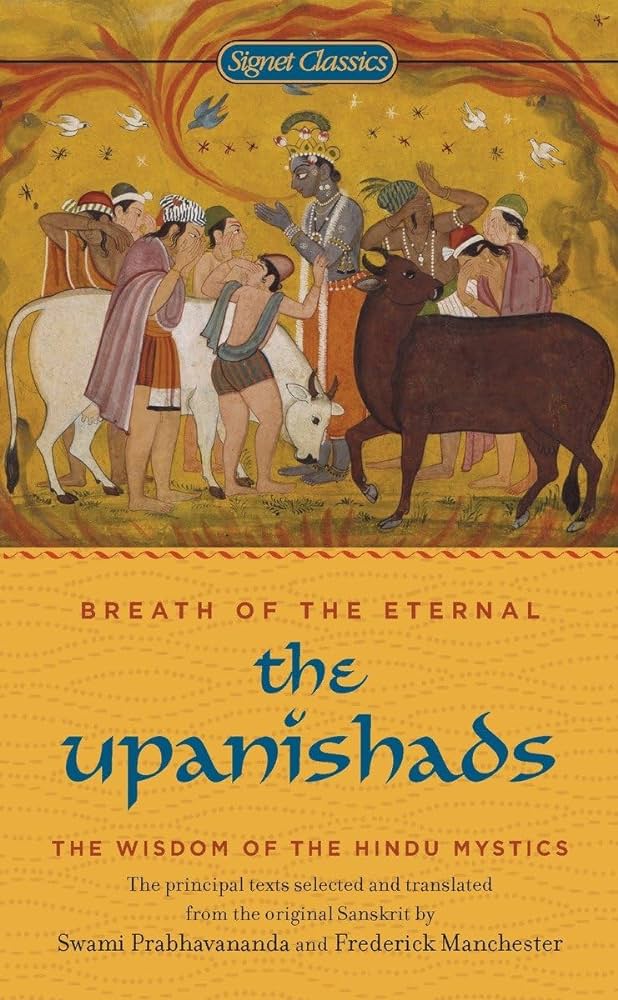
                                                                   The Upanishads, along with the Vedas and the Puranas, are the second of the three central texts of Hinduism, written around 600 BC. The version referenced here is the popular translation by Swami Prabhavananda (Signet 1948). They represent a unique approach to spiritual achievement. Where the Vedas promote specific mantras and rituals, and the Puranas relate the educational legends of our various deities, the Upanishads are a primarily philosophical text focused exclusively on the attainment of the One Higher Intelligence. Renounce the world, meditate on your Third Eye, think of nothing else but God, and repeat the mantra ‘OM’ until you reach a state of Eternal Bliss. This is the core of what is in the Upanishads, repeated over and over, in different...

Bholenath Parivar (Lord Shiva Family) Favorite Things

Image
                                                                               

The Puranas

Image
                                                                                  Link to Companion Podcast The Puranas:  Select Quotes and Commentary from " Mahagatha" by Satyarth Nayak This is a book which samples various stories from the Puranas, principle Hindu texts about the lives and times of our various deities. Through these stories we are given guidance on how best to live life and produce spiritual achievement. Overall, I highly recommend it as a reader’s digest of the main Hindu epic stories outside of the Ramayan and Mahabharat, which of course are their own epics. It is not the complete set of Puranas, just a selection of 100 key stories as the title suggests. Given that our sacred number is 108, I am surprised that Satyarthji, th...

The Vedanta Society

Image
                                                         Pranam brothers and sisters. Thanks to my illustrious cousin, I visited the Vedanta Society in the upper west side of NYC last night for a session of their weekly Gita discussion. Places led by Swamis such as these often borrow much from Hinduism but do not have representations of God on the premises, and so I have no issue with it but as a loving devotee of Bholenath it does not make sense for me to return unless there is some pressing business need to do so. I think spiritual teachers are great, but as my time on this Earth grows dearer each day, I have no wish to spend any of my life essence worshipping other human beings when I could be dripping in the bliss of Bholenath and Mother Parvati. Respecting and honoring human teachers is great, but worship? Nah. This is the same reason why ...

A New Hindu Order

Image
Organized Hinduism is evolving in Western developed nations. The way things have been practiced until now was the right thing for the initial diaspora, but their now assimilated offspring and future generations are losing both a knowledge of the underlying language (primarily Hindi and Sanskrit) and an appreciation for the teachings, tools, and symbolism, lovingly gifted to us by Saraswati Ma, that have been our pillars since the dawn if time. The Kali Yuga [i] is upon us, and unproductive influences are everywhere. Our youths are being programmed to chase superficial goals, and devalue themselves in the desperate pursuit of living up to the standards set for them by the (sometimes vapid) societies we now find ourselves in. In many cases, there is nothing wrong with that, however the spiritual component is mission critical for us to execute on our dharma and has kept many at-risk youths out of the courtroom, jail yard, and mental asylum. In order to do this, we can learn a lot from ...